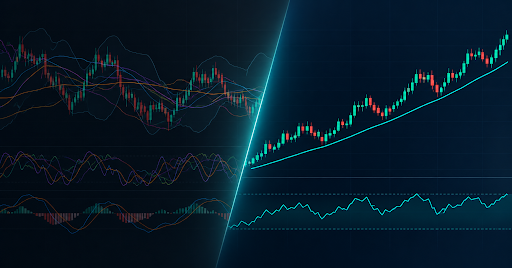
Every trader eventually hears about "the setup" — the specific pattern or condition some mentor, forum post, or YouTube video swears by. Most of these are shared with a handful of screenshots and a story, never a sample size. A trading setup built that way isn't a setup at all; it's a hunch with a name attached.
This guide covers what actually separates a trading setup worth trusting from one that just looked good a few times — how to define it precisely, where traders go wrong building one, and how to validate it before any real capital is involved.
What separates a real trading setup from "I saw this work once"
A real trading setup is a defined, repeatable set of conditions that produces a trade signal — not a vague feeling that a chart "looks like" something you've seen before. The test is simple: could someone else follow your written rules and identify the same setups you would, on the same charts, without needing to ask you anything? If the answer is no, the setup still lives in your head, not on paper, and that's a problem, because anything that lives only in your head bends under pressure.
"I saw this work once" is pattern-matching on a sample size of one. Markets produce enough randomness that almost any pattern will "work" a few times by chance alone. A real setup needs to be defined precisely enough to test across dozens or hundreds of occurrences before you trust it with money.
Defining your setup's rules precisely — entry, stop, target, conditions
A trading setup worth testing needs every one of these spelled out in advance, not decided in the moment:
- Entry condition. The exact trigger — a specific price action, indicator condition, or structural event, defined precisely enough that two people would identify the same entry point.
- Stop-loss placement. Where, structurally, the idea is proven wrong, not an arbitrary percentage chosen after the fact.
- Target or exit logic. A defined profit target, trailing method, or exit condition — decided before entry, not improvised once the trade is open.
- Market conditions it applies to. Does this setup work in trending markets, ranges, or both? Specifying this upfront prevents forcing a trend-following setup into a choppy range.
- Position sizing rule. A consistent method for how much to risk per occurrence, so results aren't skewed by inconsistent sizing across trades.
If you can't write these five elements down in a sentence each, the setup isn't ready to be tested yet, let alone traded.
Why most traders skip the validation step
Validation is tedious. It means going back through historical data, counting occurrences, and tallying results honestly, including the losses. Most traders skip straight from "this looks good" to trading it live, for a few predictable reasons:
- Impatience — wanting to trade the idea now, not spend days testing it first.
- Overconfidence from a handful of recent wins, which feels like proof but isn't.
- Not knowing how to test it systematically, especially without the right tools.
The cost of skipping validation isn't always obvious immediately. A setup with a poor underlying edge can still produce a winning streak early on through pure variance, which reinforces the decision to skip testing — right up until the inevitable losing streak reveals the setup never had a real edge to begin with.
Common trading setup mistakes — too many conditions, not enough sample size
Two mistakes show up constantly once traders do start trying to validate setups:
- Too many conditions. Adding filter after filter until the setup only fires in a handful of "perfect" instances. This often produces a great-looking backtest with almost no real-world occurrences to trade, and a setup that rarely triggers isn't especially useful.
- Testing on too small a sample. Ten or twenty occurrences aren't enough to separate genuine edge from random variance. A setup needs a meaningfully larger sample, and ideally results that hold up across more than one market condition, before it's trustworthy.
A useful gut-check: if a setup only "works" on a specific handpicked set of charts you chose because you already knew the outcome, it hasn't been tested. It's been curated.
Validating your trading setup with a trading strategy simulator
Before risking real capital, run your rules through a trading strategy simulator — testing entries, stops, and targets against historical data to see whether the setup actually holds up, or whether it only looked good in hindsight on a handful of charts. A simulator forces the precision that validation requires, since you can't backtest a rule you haven't actually defined.
This step also surfaces problems you won't see just by eyeballing charts — such as a setup's win rate looking fine while its risk-reward ratio quietly makes it unprofitable over a larger sample, or a setup performing well in one type of market and poorly in another.
How many trades you need before trusting a setup's stats
There's no single magic number, but a few guidelines help:
- Below 30 occurrences, treat any statistics as provisional at best — too small a sample to separate real edge from noise.
- 30–100 occurrences starts to give a usable picture, particularly if the setup's logic is simple and the market conditions during the sample were reasonably varied.
- 100+ occurrences, ideally spanning more than one type of market condition (trending and ranging), gives a much more reliable read on whether the edge is real.
Even with a large sample, markets change over time, so periodically re-validating a setup against more recent data is worth doing rather than assuming an edge found two years ago still holds today.
TickForge is free to start. Build and backtest your trading setup's rules against historical data before committing real capital, and see the win rate, expectancy, and drawdown behind it rather than just a feeling that it works.
FAQ
- What is a trading setup?
A trading setup is a defined, repeatable set of conditions — entry trigger, stop-loss, target, and the market conditions it applies to — that produces a consistent trade signal. It differs from a vague pattern or hunch in that someone else could follow the written rules and identify the same signals.
- How do I know if my trading setup is actually good?
A trading setup should be tested against a meaningful sample of historical occurrences, ideally 100 or more spanning different market conditions, before being trusted. Metrics like win rate, average risk-reward, expectancy, and maximum drawdown give a clearer picture than simply reviewing a handful of recent winning trades.
- What's the difference between a trading setup and a trading strategy?
A trading setup usually refers to a specific entry pattern or condition, while a trading strategy is the broader framework that includes the setup along with risk management, position sizing, and overall market approach. In practice, the terms are sometimes used interchangeably.
- Do I need coding skills to backtest a trading setup?
Not necessarily. While some traders backtest using custom code, many modern trading strategy simulators let you define entry, stop, and target rules through a simple interface and run the test automatically, without requiring any programming knowledge.
- Why do trading setups stop working over time?
Markets evolve, and a setup that exploited a specific inefficiency or behavioural pattern can lose effectiveness as market structure, participant behaviour, or volatility regimes change. This is why periodically re-validating a setup against recent data, rather than assuming a past edge still holds, is an important ongoing habit.